
How 20W Fiber Laser Power Balances Speed, Precision, and Depth
Marking Speed vs. Resolution Trade-offs at 20W Output
A 20W fiber laser marking machine strikes a practical balance between throughput and mark quality. While higher power can increase speed, the relationship is not linear—doubling wattage does not double marking velocity across all materials. At 20W, operators achieve surface marking speeds up to 7,000 mm/s, but actual performance depends on resolution, depth, and material response. Higher pulse frequencies (30–200 kHz) support faster scanning without sacrificing dot overlap, yet high-resolution or deep marks often require slower speeds and lower pulse energy. For example, deep engraving on stainless steel typically involves multiple passes at reduced speed to incrementally remove material. A well-matched F‑theta lens—commonly 160 mm or 254 mm focal length—focuses energy into a tight spot, enhancing both speed and edge sharpness. The 20W system excels at high-contrast data matrix codes and small text (0.1–0.3 mm depth), delivering cycle times under 3 seconds per part. Crucially, independent control of laser power, frequency, and scan speed enables real-time optimization: users can accelerate marking while preserving crisp feature definition.
Minimal Heat-Affected Zone and Sub-20μm Feature Accuracy
The nanosecond-pulsed fiber architecture of a 20W laser delivers an exceptionally small heat-affected zone (HAZ)—typically under 5 µm—by tightly confining thermal energy. This prevents warping, micro-cracking, and discoloration on thermally sensitive metals like brass and thin-wall aluminum. Combined with spot sizes often below 30 µm, the system achieves sub‑20 µm feature accuracy, making it ideal for micro-component serialization in medical devices and electronics. Low heat input preserves substrate integrity and coating adhesion—unlike CO₂ or higher-power fiber lasers, which risk base-material damage or oxide layer disruption. This precision, paired with zero consumables and real-time parameter adjustment, supports traceability-critical applications in automotive, aerospace, and electronics manufacturing where repeatable, post-process-free marking is non-negotiable.
Material-Specific Performance of the Fiber Laser Marking Machine 20W
Optimal Metals: Stainless Steel, Aluminum, Brass, and Anodized Surfaces
The 20W fiber laser’s 1064 nm beam couples efficiently with metallic surfaces, delivering durable, high-contrast marks across key industrial metals. On stainless steel—including 304 and 316 grades—it produces deep black annealed marks without surface ablation, maintaining corrosion resistance vital for medical implants and marine hardware. Aluminum yields bright silver-white marks through selective oxide layer vaporization; anodized variants respond with clean, high-contrast white-on-black or dark-on-light results by precisely removing the dye layer while leaving the protective aluminum oxide intact. Brass accepts clean, gold-toned marks with negligible thermal stress—avoiding burn-through common with broader-spectrum sources. With scanning speeds up to 6,000 mm/s and a typical spot size of 15–20 µm, the system reliably marks micro-scale 2D codes and logos readable by automated vision systems. Compared to lower-wattage lasers, the 20W unit reduces cycle time by ~35% on thick-section aluminum components—boosting throughput in automotive part marking. Industrial validation confirms these marks retain contrast and legibility after rigorous testing: stainless steel marks withstand 1,000-hour salt spray exposure, and anodized aluminum marks survive 500 abrasion cycles. This consistent, standards-aligned performance across stainless steel, aluminum, brass, and anodized finishes makes the 20W fiber laser the benchmark for permanent, high-integrity marking in regulated industries.
Plastic and Coated Material Limitations—and When 20W Still Delivers Traceability
The 20W fiber laser’s 1064 nm wavelength is poorly absorbed by most plastics, often causing melting or low-contrast marks. White polycarbonate is a notable exception: with optimized parameters, it yields scannable barcodes meeting ISO/IEC 15415 verification standards. Coated metals perform far better—the laser cleanly vaporizes topcoats (e.g., paint or powder coating on aluminum or steel), exposing a bright, durable underlying surface without damaging the substrate or requiring masking. While it cannot replace CO₂ lasers for broad plastic marking, the 20W system covers ~80% of mixed-material production needs—metal tags, coated enclosures, and select engineered plastics—reducing the need for multiple dedicated marking platforms. Lab testing shows coated steel can be marked at 3,000 mm/s, and polycarbonate marks remain legible after 500 alcohol-wipe cycles. This capability lowers capital expenditure and factory floor footprint, making the 20W fiber laser a pragmatic, cost-effective solution for facilities handling diverse part families.
Total Cost of Ownership Advantages of a 20W Fiber Laser Marking Machine
Zero Consumables, <2% Downtime, and 100,000+ Hour Diode Lifespan
The 20W fiber laser eliminates recurring costs for inks, solvents, or pad-printing clichés. Its solid-state, all-fiber design has no moving optics or gas fillings—minimizing wear and simplifying maintenance. Air-cooled diode modules consistently achieve a mean time between failures (MTBF) exceeding 100,000 hours—equivalent to over 11 years of continuous operation. In real-world 24/7 production environments, this reliability translates to uptime above 98% and unscheduled downtime under 2%. Without consumable replenishment stops or routine optical cleaning, the system sustains uninterrupted marking sequences—reducing labor overhead and avoiding hidden costs from service interruptions. These attributes collectively deliver a demonstrably lower total cost of ownership than inkjet, dot peen, or traditional laser systems reliant on consumables and frequent calibration.
Energy Efficiency and Space-Saving Design vs. CO₂ or UV Alternatives
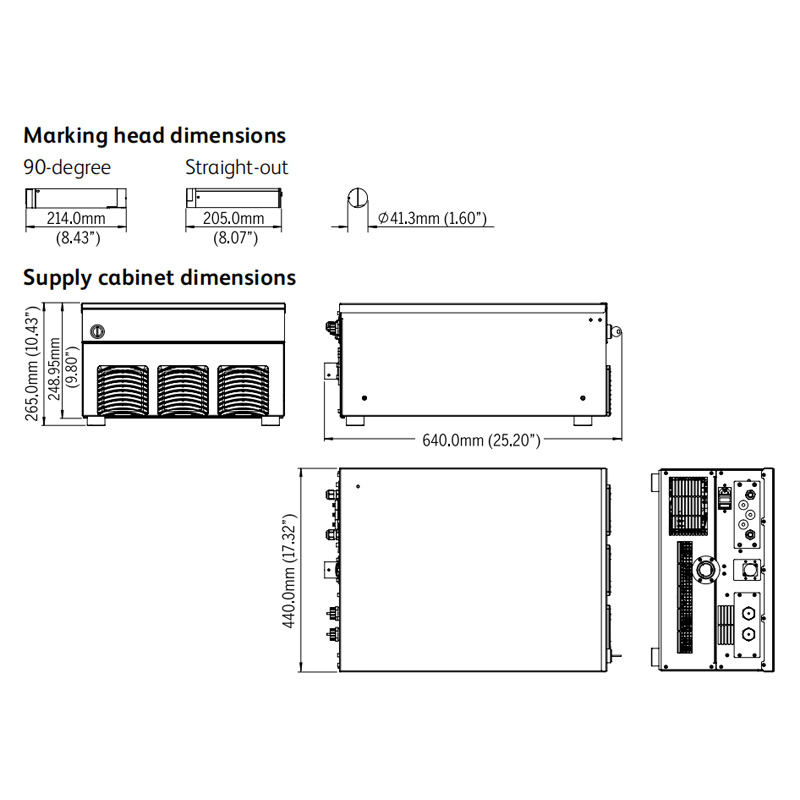
A 20W fiber laser consumes less than 0.5 kW during full-speed operation—roughly one-third the electrical draw of a comparable CO₂ system (1.5 kW+). Its electro-optical efficiency exceeds 30%, significantly outperforming gas lasers that dissipate most input energy as waste heat. This high efficiency enables compact air cooling, eliminating the need for bulky, energy-intensive water chillers and saving up to one square metre of factory floor space. In contrast, CO₂ and UV alternatives typically require dedicated cooling infrastructure and larger enclosures—increasing facility utility and footprint costs. Based on industry-reported data ($0.12/kWh, 2023), switching to a 20W fiber platform can reduce annual electricity costs by approximately $1,200 per shift—reinforcing its long-term advantage in energy-to-throughput ratio.
Real-World ROI: Where a Fiber Laser Marking Machine 20W Fits in Production Workflows
The strongest return on investment for a 20W fiber laser occurs when integrated directly into automated production cells or lean manufacturing lines. By replacing offline labeling stations and enabling in-line serialization at speeds up to 6,000 mm/s, it cuts per-part marking costs by as much as 60%—all while sustaining sub-20 µm positional repeatability. The absence of consumables and diode lifetimes exceeding 100,000 hours keep unscheduled downtime below 2%, ensuring marking never constrains line throughput. In automotive, electronics, and medical device assembly, pairing the 20W marker with vision inspection and PLC-controlled indexing delivers immediate traceability gains and supports just-in-time validation. For high-mix environments, switching between QR codes, data matrix symbols, and human-readable text requires no tooling changes—reducing changeover time from minutes to seconds. This agility directly improves overall equipment effectiveness (OEE) and accelerates payback, with many users achieving ROI within 12 months.
FAQ
What is the main advantage of a 20W fiber laser over higher power options?
The 20W fiber laser strikes an optimal balance between speed, precision, and depth. While higher power options might increase marking speeds, they often compromise precision or cause more heat-related damage, which is critical for applications requiring fine details or minimal heat-affected zones.
How does the 20W laser handle different materials?
The 20W fiber laser excels with metals like stainless steel, aluminum, brass, and anodized surfaces, creating durable, high-contrast marks. While it has limitations with most plastics, it can deliver traceability on white polycarbonate and coated metals.
What industries benefit most from 20W fiber lasers?
Industries such as automotive, aerospace, medical devices, and electronics manufacturing benefit significantly from their high precision, speed, and minimal downtime.
What is the expected lifetime of the 20W fiber laser?
The laser’s diode has a lifespan exceeding 100,000 hours, ensuring over 11 years of continuous operation with less than 2% downtime in real-world use.
How does the 20W fiber laser compare to CO₂ or UV alternatives in efficiency?
The 20W fiber laser is highly energy-efficient, consuming less than 0.5 kW during operation and offering an electro-optical efficiency exceeding 30%, making it more economical and compact than CO₂ or UV systems.