
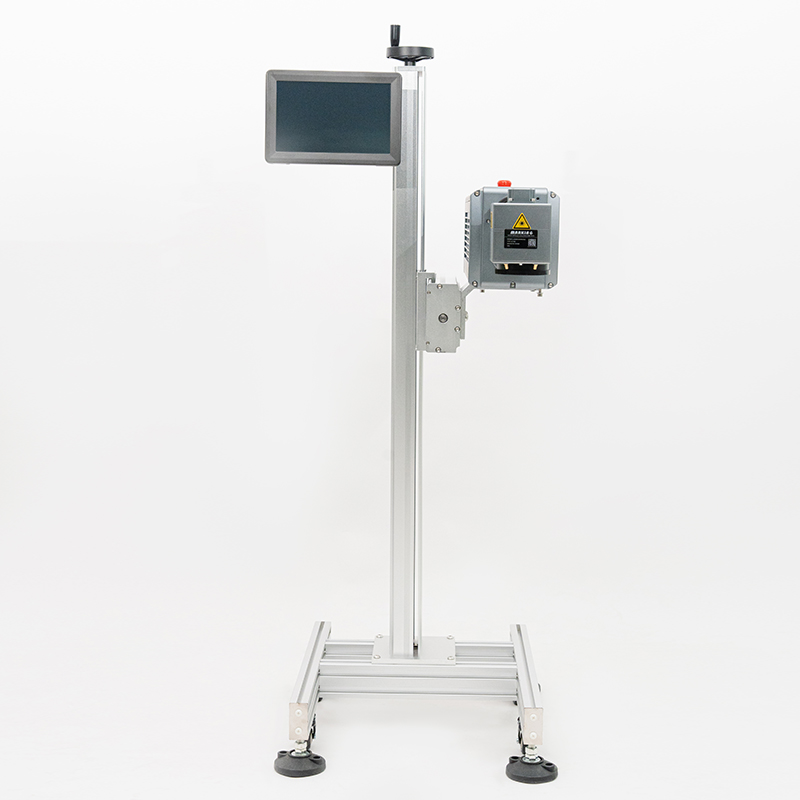
How CO₂ Laser Marking Works: Core Physics and Wavelength Dependency
Why 10.6 µm Wavelength Excels on Organic and Polymer Materials
CO₂ laser marking systems operate at a 10.6 µm wavelength in the mid-infrared range. An electric discharge excites a sealed gas mixture of carbon dioxide, nitrogen, and helium—causing CO₂ molecules to emit coherent photons that form a highly concentrated beam. This long wavelength is strongly absorbed by organic and polymer materials, including wood, leather, acrylic, ceramics, and most plastics. Absorption rates often exceed 90%, enabling efficient energy transfer as heat. The result is rapid surface vaporization or controlled discoloration—producing high-contrast, durable marks without compromising structural integrity. This fundamental wavelength–material match underpins the technology’s widespread use in packaging, consumer goods, and industrial traceability.
The Absorption Barrier: Why Bare Metals Reflect CO₂ Radiation
Bare metals reflect over 90% of incident CO₂ laser radiation due to their high electrical conductivity and dense free-electron cloud, which prevents effective coupling with the 10.6 µm photon energy. As a result, direct marking on untreated aluminum, stainless steel, or copper yields no visible or reliable mark. While localized oxidation may occur at extreme power levels, it lacks consistency and permanence. To overcome this limitation, manufacturers apply absorptive coatings—such as marking sprays, anodized layers, or painted finishes—that convert laser energy into heat, transferring it to the underlying metal. For permanent, direct-metal traceability—especially on raw surfaces—fiber lasers (1064 nm) remain the industry standard. This physical constraint defines the operational boundary of CO₂ systems: unmatched on organics and polymers, but dependent on surface modification for metals.
CO₂ Laser Marking on Non-Metals: High-Contrast, Production-Ready Performance
CO₂ laser marking delivers high-contrast, permanent, consumable-free marks on non-metal substrates. Its 10.6 µm wavelength is inherently well-matched to the absorption spectra of organic and polymeric materials, enabling crisp, legible results at production speeds. Widely adopted across packaging, signage, and consumer goods, the technology offers reliability, repeatability, and zero ongoing material costs—making it a cornerstone of modern non-contact marking.
Optimized Results on Acrylic, Wood, Leather, and Glass
Acrylic responds with a clean, frosted white contrast ideal for labels and displays. Wood engraving produces rich, dark charring—ideal for logos, barcodes, or decorative motifs—without splintering or thermal distortion. Leather absorbs uniformly, yielding soft, tactile marks that retain flexibility and durability, making it preferred for luxury accessories. Glass marking relies on controlled micro-fracturing: precise power modulation generates opaque, permanent text or graphics while avoiding catastrophic cracking. Across all these materials, fine-tuning of power, speed, and focus allows operators to balance darkness, depth, edge sharpness, and throughput—ensuring consistent, production-ready output that outperforms ink-based alternatives in longevity and regulatory compliance.
Speed and Depth Control for Functional vs Decorative Marking
Functional marking—such as UID codes, date stamps, or 2D Data Matrix symbols—prioritizes speed and surface preservation. Shallow, high-velocity passes create legible, ISO-compliant marks without altering mechanical properties. Decorative or artistic engraving, by contrast, benefits from slower scan speeds and higher peak power to achieve deeper material removal, tactile relief, or graduated shading. Modern CO₂ systems offer granular control over pulse duration, frequency, and galvo scanning velocity—enabling seamless switching between traceability-grade precision and aesthetic craftsmanship on the same platform. This adaptability supports both lean manufacturing and high-mix branding workflows.
CO₂ Laser Marking on Metals: Practical Workarounds and Realistic Expectations
Marking Sprays, Anodized Layers, and Painted Surfaces as Enablers
Direct CO₂ laser marking on bare metals is physically impractical due to near-total reflection of 10.6 µm radiation. However, three proven surface modifications enable robust marking:
- Ceramic marking sprays, applied pre-marking, thermally bond to stainless steel, brass, or chrome, forming a durable, dark oxide layer upon laser exposure;
- Anodized aluminum allows selective vaporization of the porous oxide coating, revealing a contrasting dark base layer beneath—commonly used for durable part IDs in aerospace and automotive;
- Painted or powder-coated metals permit clean top-layer ablation, exposing bare metal for high-contrast text or logos.
While each method extends CO₂ utility to metal substrates, they introduce additional process steps—surface preparation, curing, and post-marking cleaning—that affect cycle time and consistency. These workarounds are best suited for low-to-mid volume applications where fiber laser investment isn’t justified.
When to Choose CO₂ vs Fiber Laser for Metal Traceability
Fiber lasers dominate permanent metal traceability because their 1064 nm wavelength couples directly into bare metal surfaces—producing high-contrast, corrosion-resistant marks (e.g., annealed, engraved, or foamed) without consumables or prep. CO₂ lasers only become viable for metal when the substrate is pre-treated (coated, anodized, or sprayed), and even then, mark quality depends heavily on coating uniformity and adhesion. In high-volume production of raw aluminum, stainless steel, or brass components—especially where UDI, AS9132, or MIL-STD-130 compliance is required—fiber remains faster, more reliable, and more future-proof. CO₂ serves best as a cost-effective alternative when coated parts are already part of your workflow, or when multi-material versatility outweighs raw-metal performance needs.
Industrial Applications of CO₂ Laser Marking Systems by Sector
Automotive (Anodized Aluminum Components) and Medical Device Packaging (Glass/Plastic)
In automotive manufacturing, CO₂ lasers reliably mark anodized aluminum brackets, housings, and trim—vaporizing the oxide layer to expose a durable, dark identifier that resists heat, vibration, and cleaning solvents. These marks meet OEM traceability requirements without damaging the base metal. In medical device packaging, CO₂ systems excel on glass vials, plastic syringes, and polymer trays—applying sterile, non-contact markings that preserve barrier integrity and comply with FDA 21 CFR Part 11 and ISO 13485 standards. A single CO₂ platform can switch between these materials with minimal recalibration, supporting hybrid production lines serving both sectors.
Electronics Enclosures, Promotional Items, and Custom Craft Manufacturing
Electronics manufacturers use CO₂ lasers to permanently engrave logos, regulatory symbols, and component IDs onto ABS, polycarbonate, and silicone enclosures—without risk of electrostatic discharge or mechanical stress to internal circuitry. For promotional and custom craft applications, the technology enables high-resolution personalization on wood, leather, textiles, and acrylic—supporting everything from branded conference giveaways to limited-edition art pieces. With rapid job setup, no tooling, and excellent edge definition, CO₂ marking is especially cost-effective for high-mix, low-to-medium volume production—where flexibility and speed-to-market matter more than ultra-high throughput.
FAQ
1. Why does CO₂ laser marking work well on organic and polymer materials?
CO₂ lasers operate at a 10.6 µm wavelength, which is highly absorbed by organic and polymer materials, resulting in efficient energy transfer and high-contrast marking without damaging the substrate.
2. Can CO₂ lasers mark bare metals directly?
No, bare metals reflect most of the CO₂ laser radiation. Marking sprays, anodized layers, and painted surfaces are used to enable marking on metals.
3. What are common applications of CO₂ laser marking?
CO₂ laser marking is widely used on non-metal substrates like acrylic, wood, leather, and glass, as well as coated metals. It is commonly applied in packaging, automotive, medical devices, and promotional items.
4. How does CO₂ laser marking differ for decorative and functional applications?
Functional markings prioritize speed and surface preservation, while decorative engravings focus on depth, tactile relief, and aesthetic appeal by using slower scan speeds and higher power.
5. Why choose fiber lasers over CO₂ systems for bare metal traceability?
Fiber lasers operate at a 1064 nm wavelength, which directly couples to bare metals, providing durable, high-contrast, corrosion-resistant marks without the need for surface preparation.