
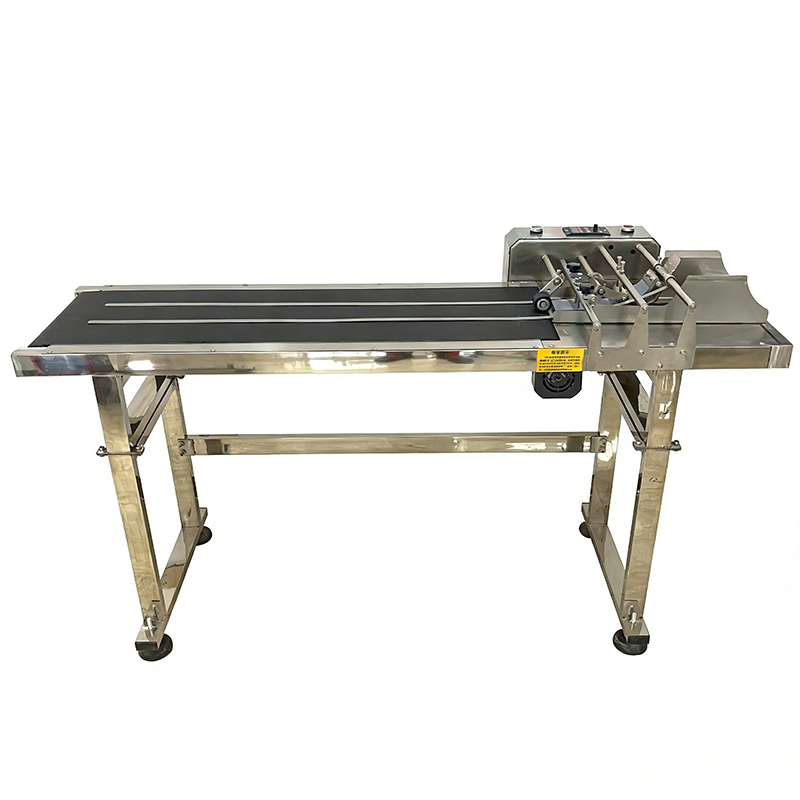
Precision Registration: How Conveyor Belt Stability Enables Sub-0.1 mm Print Alignment
The Speed-Misregistration Challenge in Continuous-Feed Printing
High-speed industrial printing faces a critical tradeoff: as production velocities exceed 150 m/min, traditional conveyor systems experience micro-slippage and tension fluctuations—causing registration errors exceeding ±0.5 mm in multi-pass applications like packaging graphics. Thermal expansion compounds the issue, with belts elongating up to 0.3% at 60°C ambient temperatures. These cumulative deviations result in color misalignment, substrate waste, and costly press downtime. Precision conveyance solves this by maintaining positional accuracy within microns through engineered materials and advanced control systems.
Dynamic Tension Control and Closed-Loop Belt Tracking Technologies
Modern solutions integrate three synergistic stabilization technologies:
- Active tension modulation: Servo-driven rollers adjust tension 500 times per second, compensating for inertial forces during acceleration and deceleration
- Laser-guided tracking: Infrared sensors detect lateral drift and trigger real-time micro-adjustments to maintain belt alignment within ±0.05 mm
- Positive-drive belt systems: Tooth-in-sprocket mechanisms eliminate slippage entirely, delivering positional repeatability of 0.001 mm/meter
Together, these counteract the root causes of print misregistration—variable friction coefficients, roller eccentricity, and thermal distortion—without relying on external calibration or manual intervention.
Real-World Validation: UV Inkjet Line Achieving ±0.05 mm Accuracy at 300 m/min
A flexible packaging converter recently integrated PTFE-coated polyimide belts with dynamic tension control and laser-guided tracking—achieving unprecedented performance across an 18-hour production run:
| Parameter | Before Implementation | After Implementation |
|---|---|---|
| Registration Error | ±0.35 mm | ±0.05 mm |
| Line Speed | 180 m/min | 300 m/min |
| Substrate Waste | 5.2% | 1.1% |
| Downtime | 14 hours/week | 2 hours/week |
This 300 m/min UV inkjet system sustained sub-0.1 mm registration accuracy consistently—not through isolated component upgrades, but via holistic conveyor belt stability: closed-loop servo control eliminated cumulative slippage, while thermally stable belt materials prevented drift from ambient heat.
Material-Specific Conveyor Belt Design for Print-Ready Substrate Handling
Mitigating Slippage and Thermal Warping with Engineered Surface Coatings
Engineered surface coatings directly address high-speed printing challenges—friction-induced slippage and thermal warping—by precisely tuning coefficient of friction (COF) and thermal dissipation. Micro-textured polyurethane coatings enhance grip on smooth films without scratching, while thermally conductive silicone layers rapidly dissipate localized heat, preventing expansion-related distortion. Crucially, these coatings also suppress static buildup—vital for thin, non-conductive substrates like metallized PET or release liners. When matched to substrate hardness and surface energy (e.g., paper vs. foil vs. polyolefin), they deliver consistent transport, eliminate re-tensioning cycles, and extend belt service life—even above 300 m/min.
PTFE-Embedded Polyimide Belts: Low Friction, High Heat Dissipation, and Static Control
For heat-sensitive substrates and high-temperature processes, PTFE-embedded polyimide belts provide a unified solution. The polyimide base withstands continuous operation up to 260°C, while the PTFE surface delivers ultra-low friction—reducing drag-induced misalignment and preventing adhesive residue accumulation. Critically, the composite structure is inherently static-dissipative, eliminating dust attraction and electrostatic discharge risks common with solvent-based inks or electronics-grade packaging. This integration removes dependency on antistatic sprays or auxiliary cooling zones—streamlining line design while preserving sub-0.1 mm register fidelity under thermal and mechanical load.
Smart Conveyor Belt Integration: Sensor Fusion and Real-Time Synchronization with Printers
Eliminating Timing Drift via Encoder-Vision-Servo Feedback Loops
Timing drift remains a leading cause of print defects in continuous-feed lines—but sensor fusion closes the loop decisively. By integrating high-resolution encoder data, real-time vision inspection, and servo motor response into a single closed-loop architecture, smart conveyors correct positional errors in under 5 milliseconds. In packaging applications, this maintains bottle or carton alignment within ±0.5 mm—even at speeds exceeding 500 units per minute. As documented in industry benchmarking studies, such integrated systems reduce human handling errors by nearly 78%, transforming the conveyor from a passive transport medium into a responsive, real-time motion partner synchronized to printer firing and labeling events.
Edge-AI Sensors Reducing Manual Intervention by 78% in Packaging Print Lines
Edge-AI sensors embedded directly into the conveyor structure perform local analysis of pattern deviation, belt wear, and substrate positioning—triggering autonomous self-tuning adjustments without cloud latency or central controller dependency. In packaging print lines, this reduces manual realignment and fault detection tasks by 78%, virtually eliminating operator-initiated downtime. The sensors maintain fill-level consistency monitoring at 99.9% accuracy across diverse container geometries and speed variations—enabling resilient, low-touch production where the conveyor belt dynamically synchronizes with printer output, label applicators, and downstream inspection stations.
FAQ Section
What causes print misregistration in high-speed printing?
Print misregistration in high-speed printing often results from micro-slippage, tension fluctuations, roller eccentricity, and thermal expansion. These inconsistencies lead to alignment errors, waste, and operational inefficiencies.
How does dynamic tension control help in print alignment?
Dynamic tension control employs servo-driven rollers that adjust tension hundreds of times per second, compensating for inertial forces and ensuring precise positional accuracy.
What materials are used in engineered conveyor belts for high-speed printing?
Engineered conveyor belts often incorporate materials like PTFE-coated polyimide for heat resistance, low friction, and static control, along with polyurethane and silicone coatings for optimized grip and thermal dissipation.
What role do Edge-AI sensors play in conveyor systems?
Edge-AI sensors perform local analysis of deviations and make autonomous adjustments to conveyor operations, reducing manual interventions, downtime, and print defects significantly.
Why is sensor fusion important in continuous-feed printing systems?
Sensor fusion integrates encoder, vision, and servo data into a closed-loop system that rapidly corrects positional errors, ensuring consistent alignment even at high speeds.