Why Domino Ink Cartridges Directly Impact Production Yield
Domino ink cartridges directly influence production yield because they govern ink stability, drop consistency, and code legibility across every production shift. When cartridge-level ink properties remain stable, high-speed lines sustain throughput; when they degrade, yield falls quickly.
How Ink Instability Causes Downtime and Rejects in High-Speed Coding
Ink instability is a primary cause of unplanned downtime on high-speed coding lines. Three failure modes dominate: pigment settling, viscosity drift, and air entrainment. As pigment settles, nozzle orifices clog partially, causing curved or missing drops. Viscosity drift changes droplet volume and velocity, shifting print placement even when nozzles fire. Air bubbles created by poor cartridge seals or rapid pressure changes collapse thermal inkjet bubbles mid-ejection, producing intermittent void characters. At line speeds of 25,000 units per hour, a single missing dot in a lot code or expiry date is enough to make the code unreadable. Operators then stop the line for nozzle purges, printhead cleaning, or full cartridge replacement. A 2023 packaging audit recorded an average of 4.2 ink-related stops per shift, each lasting six to eight minutes—translating to roughly 2,900–3,300 lost units per stop on a high-speed beverage line. These stoppages also generate re-inspection labour, damaged secondary packaging, and increased scrap. Stable Domino ink cartridges mitigate these failure modes by maintaining filtration, degassing, and viscosity within narrow limits, keeping drop placement consistent and production yield higher. This is why ink stability is treated as a line-performance variable, not just a consumable property.
Yield Loss Quantified: Real-World Data from Beverage and Pharma Lines
Yield loss from ink-related failures appears in hard financial terms, especially when comparing beverage and pharmaceutical lines. A 2023 beverage plant running 60,000 containers per hour lost about 10,000 units in a single 10-minute coding stoppage. At an average unit margin of $0.074, that equals $740 per incident—before restart scrap and labour. Over three shifts daily, monthly yield loss exceeded $160,000. Pharmaceutical lines face lower speeds but much higher unit value and regulatory risk. A 2023 pharma packaging audit found that 3% of rejected cartons traced back to inkjet code defects, with rework costs averaging $1.20 per carton. On a line producing 18,000 cartons per hour, a 10-minute illegible code event quarantined roughly 3,000 cartons and cost approximately $3,600 in rework and inspection. The comparison below shows why stable Domino ink cartridges are yield-critical.
| Line Type | Speed | 10-Minute Failure Impact | Estimated Yield Loss |
|---|---|---|---|
| Beverage canning | 60,000 units/hour | 10,000 containers scrapped or reworked | $740 per incident |
| Pharma cartoning | 18,000 cartons/hour | 3,000 cartons quarantined/reworked | $3,600 per incident |
This quantification makes the case clear: ink stability is not a consumable detail but a direct yield lever. Domino ink cartridges engineered for consistent drop formation and substrate adhesion keep both line types closer to validated output targets.
Ink Chemistry Matters: Formulation Science Behind Domino Ink Cartridges
Solvent Systems, Pigments, and Additives That Maximize Drop Consistency
Solvent systems, pigments, and additives determine whether Domino ink cartridges deliver repeatable drop volumes and clean code edges. Solvent choice controls drying rate and wetting on substrates. Fast-evaporating solvents such as methyl ethyl ketone (MEK) or ethanol enable quick adhesion on non-porous surfaces—but uncontrolled evaporation can raise viscosity at nozzles. Slower solvents improve open time yet may smear on high-speed lines. Pigment dispersion is equally critical: particles must remain below the nozzle diameter—typically under 0.5 micrometers—to prevent agglomeration and clogging. Dispersants and surfactants stabilize pigment surfaces and reduce surface tension for uniform droplet formation. Without them, pigment settling alters color density and drop trajectory. Binder resins anchor pigment to the substrate after impact, improving rub and chemical resistance. A balanced formulation keeps viscosity within narrow limits—usually 1–10 centipoise for thermal inkjet (TIJ) systems—minimizing satellite droplets and ensuring consistent contrast and barcode readability.
Thermal Stability and Viscosity Control in TIJ-Specific Domino Ink Cartridges
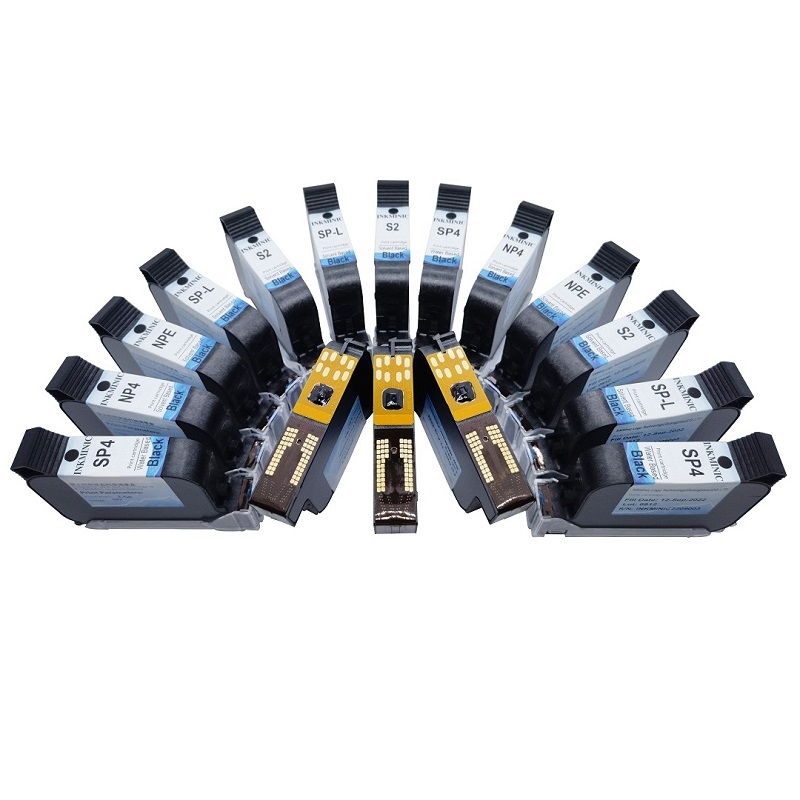
Thermal inkjet (TIJ) printheads use rapid resistive heating, often reaching 300°C at the nozzle for microseconds. Ink must maintain low viscosity at jetting temperature while staying stable in storage. In TIJ-specific cartridges, co-solvents such as glycols or glycol ethers prevent water loss and keep nozzles from drying between print cycles. Viscosity creep from evaporation is a leading cause of start-up failures. Manufacturers formulate with humectants and viscosity modifiers to hold viscosity within 2–6 centipoise across a 15–35°C operating range. Thermal stability prevents dye or pigment breakdown that forms residue on heater elements—a condition known as kogation. Kogation reduces bubble formation and drop velocity, causing light print or missing dots. Quality cartridges use purified deionized water and filtered colorants to limit ionic contaminants. This thermal control extends cartridge life and maintains crisp alphanumeric codes, barcodes, and 2D data matrices across shifts.
Matching Domino Ink Cartridges to Substrates and Printers
Compatibility Matrix: PET, Glass, Metal, Corrugated, and Flexible Films
Matching Domino ink cartridges to the correct substrate prevents adhesion failure, smearing, and unreadable codes. Use the following compatibility matrix as a quick production reference:
| Substrate | Recommended Ink Type | Key Consideration |
|---|---|---|
| PET | High-adhesion, fast-drying solvent or TIJ ink | Surface energy above 38 mN/m; avoid silicone release agents |
| Glass | Pigmented, abrasion-resistant ink | Pre-treat with primer or flame treatment for wet environments |
| Metal | Solvent-based, quick-cure ink | Remove oil films; use MEK or TIJ ink for high line speeds |
| Corrugated | Low-bleed, high-contrast water-based ink | Test porosity; adjust throw distance to reduce feathering |
| Flexible Films | Flexible, stretch-resistant ink | Formulation must survive film elongation and lamination |
Selecting the correct cartridge chemistry for each substrate reduces ink waste, extends cartridge life, and keeps codes legible at full production speed.
Operational Best Practices to Extend Domino Ink Cartridge Life
Storage, Handling, and Preventive Maintenance to Avoid Clogging and Waste
Store Domino ink cartridges in cool, dark, dry conditions away from heat sources and direct sunlight. Keep protective caps on nozzles whenever cartridges are not installed. Use first-expired, first-out rotation, and discard expired ink before it degrades the printhead. Train operators on careful wiping, purging, and handling to prevent contamination. Inspect nozzles during shift changes and clean only with approved wipes. Avoid touching nozzle plates with bare hands. If a production stop exceeds the manufacturer’s decap time, remove cartridges or purge and wipe nozzles before restarting. These habits reduce clogging and cut waste.
FAQ
Why is ink stability crucial for production yield?
Ink stability ensures consistent ink properties like viscosity and drop formation, which are essential for maintaining clear and legible codes. Instability can lead to downtime, product rejects, and yield loss due to interrupted production lines and defective packaging.
How does ink chemistry impact the performance of Domino ink cartridges?
Ink chemistry, including solvent systems, pigments, and additives, plays a crucial role in drop consistency, drying time, and adhesion to various substrates. A well-balanced formulation enhances code legibility and productivity.
What substrates are compatible with Domino ink cartridges?
Domino ink cartridges are compatible with a wide range of substrates, including PET, glass, metal, corrugated materials, and flexible films. Choosing the correct ink type for each substrate ensures better adhesion and performance.
How can I prolong the life of my Domino ink cartridges?
To extend the life of your ink cartridges, store them in a cool, dry, and dark place, maintain proper sealing, and ensure cartridges are handled with care. Follow preventive maintenance practices like checking and cleaning nozzles during shift changes.
What is the financial impact of ink-related production stops?
Ink-related production stops can result in significant financial losses. For example, a beverage plant can lose $740 in just a 10-minute coding stoppage at 60,000 units per hour, while pharmaceutical lines might lose $3,600 in rework and inspection costs during a similar stoppage.