Jan 08,2026
In the field of laser marking, precision and consistency directly determine a product's brand perception, traceability efficiency, and market competitiveness, and serve as the core cornerstone for maintaining customer satisfaction. As a professional manufacturer specializing in the R&D and production of laser marking equipment, we have always focused on three core product categories: fiber laser marking machines, carbon dioxide (CO₂) laser marking machines, and UV laser marking machines. All three types of equipment have become the mainstream choice for permanent marking across various industries, thanks to their advantages such as non-contact processing, permanent and wear-resistant markings, high efficiency, and environmental friendliness.
However, a key fact overlooked by many customers is this: even for the same material, these three laser technologies operate on fundamentally different principles, resulting in vastly distinct marking effects. Compounded by the inherent variations in composition, density, and surface properties across different materials, even products made of the same "canvas fabric"—such as canvas bags—can react very differently to laser processing depending on batch differences and gram weight variations. Therefore, we always emphasize that sending samples for testing prior to formal cooperation is never an optional step, but a necessary prerequisite to ensure the marking effect precisely meets requirements and even exceeds expectations.
Next, we will take the common canvas bag as an example to conduct an in-depth analysis of the working principles and specific marking effects of fiber and CO₂ laser marking machines, enabling a clear understanding of their core differences.
Let us first look at fiber laser marking machines. Their core working principle involves using a fiber laser to generate a laser beam with high energy density, which is then precisely focused onto a micro-area on the canvas surface via a focusing system. The laser energy is rapidly absorbed by the fibers and dyes on the canvas surface, causing instantaneous vaporization or melting of the local material, thereby forming clear recessed marks on the canvas surface. Fiber lasers typically have a wavelength of 1064 nm—a wavelength that is highly absorbed by both natural plant fibers (such as cotton and linen) and synthetic fibers in canvas. With shallow penetration depth, it acts precisely on the surface layer without easily piercing through the canvas and damaging the back side.
When applied to canvas bags, fiber laser marking machines deliver distinct effects: the marked lines are sharp and well-defined, presenting a typical "engraved" finish. Tactilely, the marks have a noticeable concave-convex texture; visually, they form strong contrast against the canvas’s original color. For dark-colored canvas (e.g., black and navy blue), the marks appear in light gray or off-white; for light-colored canvas (e.g., off-white and light gray), the marks turn dark brown or charred black. The primary advantage of this effect is exceptional wear resistance—even after repeated washing, friction, and folding, the marks remain clear and intact, without easy fading or blurring. This makes it ideal for marking information requiring long-term durability and high wash resistance on canvas bags, such as brand logos, limited-edition serial numbers, and eco-labels. However, it should be noted that the color contrast of fiber laser marks is highly influenced by the type and dyeing depth of the canvas dyes. If the canvas dye absorbs the 1064 nm laser unevenly, the marks may exhibit inconsistent color intensity. Additionally, since the process involves vaporizing the surface fibers, improper parameter settings may result in slight "charred edges" or fiber fraying around the marks, compromising visual aesthetics.
Next is the CO₂ laser marking machine. Its working principle relies on carbon dioxide gas as the gain medium, which generates mid-infrared laser with a wavelength of 10.6 μm under electrical discharge excitation. The core characteristic of this laser is its strong absorption by organic materials. As canvas is primarily composed of natural plant fibers (cotton, linen) or synthetic fibers (polyester)—all organic substances—it can efficiently absorb the laser energy at 10.6 μm wavelength. Unlike fiber lasers, CO₂ lasers not only vaporize the surface material of the canvas but also cause partial decomposition of surface dyes or mild carbonization of fibers to form marks.
When used on canvas bags, CO₂ laser marking machines produce effects more akin to "carbonization" or "bleaching":
For natural fiber canvas, the marked areas develop dark brown or black traces due to mild carbonization of surface fibers, typically offering high color contrast and clear visibility.
For coated canvas (e.g., canvas bags with waterproof or matte coatings), the laser causes vaporization of the surface coating or fading of dyes, creating marks with distinct contrast against the base color.
Tactilely, CO₂ laser marks have a weaker concave-convex texture compared to fiber laser marks; on some lightweight canvas materials, the marks may even appear nearly flat. Its key advantages include broad adaptability to various canvas types—it can stably mark both heavy-duty industrial canvas and lightweight casual canvas—and relatively fast marking speed, making it suitable for batch processing needs (e.g., mass customization of cultural and creative canvas bags or promotional canvas bags). However, its limitations are equally evident: the wear and wash resistance of the marks are slightly lower than those from fiber lasers. Under long-term high-frequency washing or friction conditions, the edges of CO₂ laser marks may become slightly blurred. Furthermore, for light-colored canvas with low dye content, CO₂ laser marks may suffer from insufficient color contrast, resulting in less prominent markings.
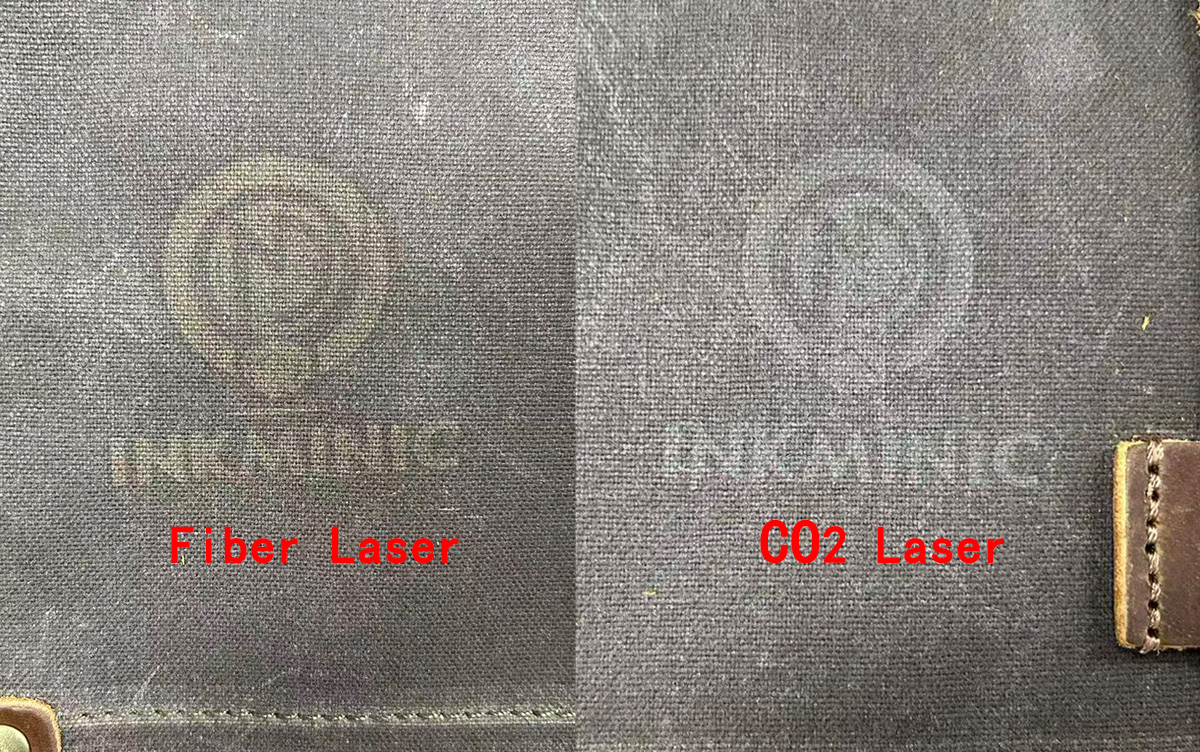
Through this analysis of the two laser marking technologies’ performance on canvas bags, it is clear that even for the same canvas material, different laser technologies yield vastly different marking results in terms of core metrics such as clarity, contrast, tactile feel, and wear resistance. And this only accounts for scenarios involving "the same material." In actual production, canvas bag materials are extremely diverse—ranging from natural fiber canvas (pure cotton, pure linen, cotton-linen blends) to synthetic fiber canvas (polyester, nylon, polyester blends), and further to functional coated canvas (waterproof, stain-resistant, flame-retardant coatings). These materials exhibit significant variations in fiber density, dye adhesion, and surface smoothness. Even for the same category of canvas, differences in textile manufacturing processes, dyeing techniques, and setting procedures across batches can lead to substantial variations in laser absorption and reaction effects. For instance, two batches of black pure cotton canvas bags—one dyed with reactive dyes and the other with pigment dyes—may produce completely different color contrast and charring effects when processed with fiber lasers. Similarly, for polyester canvas bags, matte-coated surfaces and high-gloss coated surfaces will show distinct fading effects after CO₂ laser marking.
This is the core reason why we strongly require customers to send samples for testing before formal cooperation. First, sample testing helps customers accurately select the laser marking machine type that best aligns with their specific needs. Different customers have varying marking requirements for canvas bags: some prioritize maximum wear and wash resistance for outdoor canvas bags intended for long-term use; others focus on aesthetic finesse and demand that markings do not compromise the canvas’s hand feel; still others require sharp, high-contrast marks for brand display or advertising purposes. By sending samples for testing, we can evaluate the performance of different laser marking machines based on the customer’s exact requirements and ultimately recommend the most suitable equipment—preventing mismatched marking results caused by incorrect equipment selection.
Second, sample testing enables precise parameter calibration to ensure consistency and stability. As previously noted, canvas materials have inherent variability; even within the same batch, minor differences may exist. Through repeated testing on customer-provided samples, we can accurately adjust core parameters such as laser power, frequency, scanning speed, and focal height to identify the optimal parameter combination for that specific batch of canvas. This ensures clear, uniform marking effects and maintains high consistency during mass production, avoiding issues where some products have blurred marks while others have overly deep ones.
Last but not least, sample testing helps pre-empt risks and reduce cooperation costs. For customers, sending small-sized samples incurs almost no cost but allows them to verify in advance whether the marking effect meets expectations. This avoids unnecessary losses such as equipment idleness or production rework that may arise if batch-purchased equipment fails to deliver satisfactory results. For us, sample testing provides deeper insights into customer needs, enabling us to offer more tailored solutions and enhance cooperation satisfaction.
In conclusion, there is no "one-size-fits-all" equipment in the laser marking industry—only the most suitable solutions. Sending samples for testing is by no means a redundant step; it is a necessary prerequisite to ensure marking effects meet precise standards and achieve a win-win outcome for both customers and manufacturers. We always recommend that customers proactively send samples at the initial stage of cooperation, allowing us to leverage professional testing and calibration to deliver laser marking solutions perfectly tailored to their needs—ensuring every mark becomes a value-adding enhancement to product quality.