
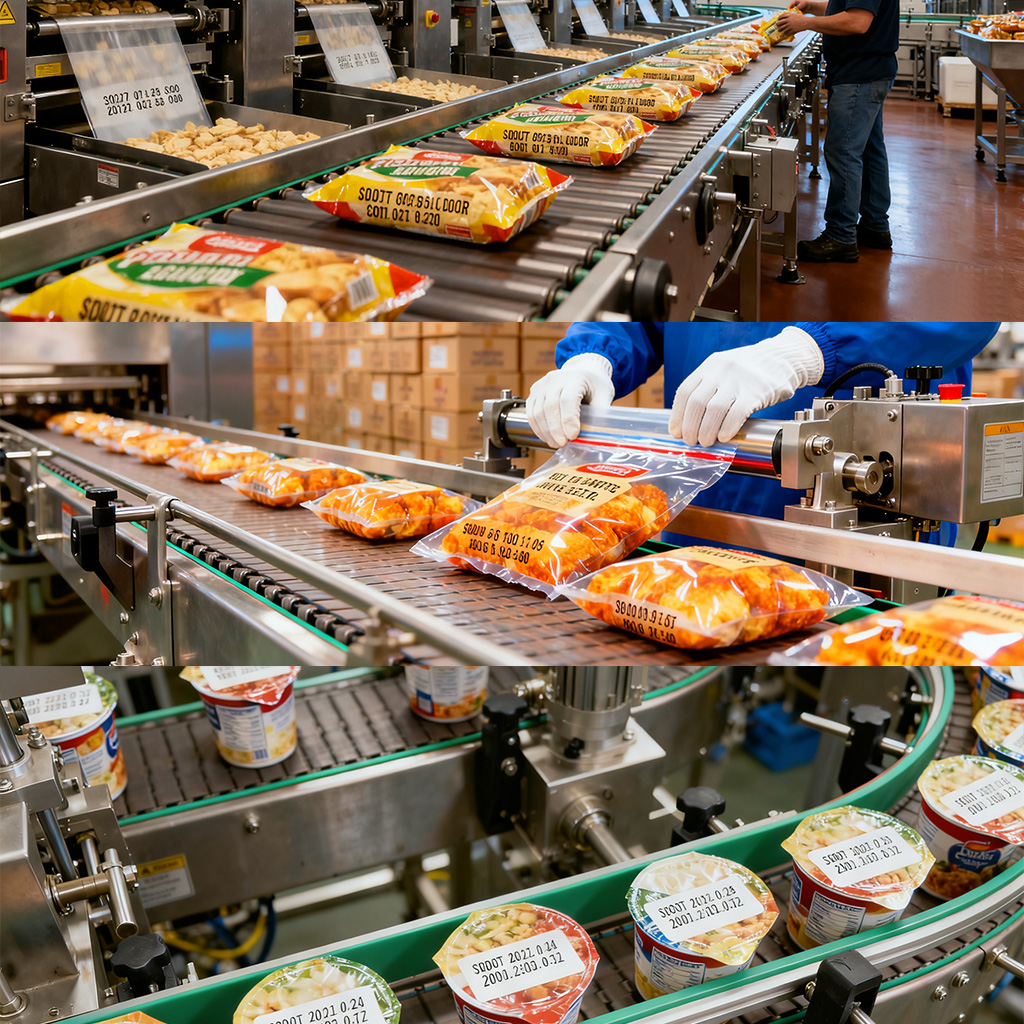
The selection of a coding machine requires comprehensive consideration of multiple factors such as resolution, printing speed, and ink compatibility. Below are the characteristics and purchasing suggestions for CIJ (Continuous Ink Jet), TIJ (Thermal Ink Jet), TTO (Thermal Transfer Overprinting) and Laser Coding Machines:
1.CIJ Coding Machine
Working Principle
Ink is ejected from the nozzle under pressure to form a stream of ink droplets. The ink droplets are then charged and deflected by an electric field, thereby printing the required patterns and text on the product surface.
Features
High printing speed: It can meet the needs of high-speed production lines. For example, small-character coding machines can print 1,000-3,000 bottles per hour.
Wide material applicability: Suitable for various materials such as plastic, glass, metal, paper, etc.
Consumable & maintenance needs: Ink consumption is relatively fast, requiring regular ink replacement and nozzle maintenance.
Application Scenarios
Commonly used for coding on bottled and canned products in mass production, such as beverages, soy sauce/vinegar bottles, and canned food containers.
2.TIJ Coding Machine
Working Principle
The ink inside the nozzle is heated to vaporize instantly and form bubbles. The expansion of the bubbles pushes the ink out of the nozzle, thus forming prints on the product surface.
Features
High resolution: It can reach up to 600 DPI or even higher, capable of printing fine text and patterns.
User-friendly design: Compact in size, easy to operate, and low maintenance cost.
Speed & ink limitations: Printing speed is slower than that of CIJ coding machines; the ink capacity is limited, requiring frequent cartridge replacement.
Application Scenarios
Suitable for occasions requiring high coding precision and not extremely fast production speed, such as small electronic components, cosmetic packaging, and small food packaging.
3.TTO Coding Machine
Working Principle
It uses a thermal transfer printhead and thermal transfer ribbon. The printhead heats up to transfer the ink on the ribbon to the coding material in the designated target area, thereby generating codes.
Features
Excellent performance on flexible materials: Can create high-resolution and legible codes on flexible films or labels, capable of printing clear text, patterns, barcodes, etc.
Easy integration & operation: Can be seamlessly integrated with packaging equipment; it is convenient to change printing content without preheating like traditional hot stamping technology.
Ribbon cost factor: Requires regular ribbon replacement, and the cost of ribbons is relatively high.
Application Scenarios
Specialized in coding on flexible film packaging and labels, such as pastries, packaged snacks, candy and chocolate packaging in the food industry.
4.Laser Coding Machine
Working Principle
It uses the energy of a laser beam to etch, melt or vaporize the product surface, thereby forming permanent marks.
Features
Permanent marking: The marks are highly durable, resistant to wear, high/low temperatures, and corrosion.
Low operating cost: No consumables are needed.
High initial investment & color limitation: The upfront equipment cost is relatively high; it can only print monochromatic marks, usually white or black.
Application Scenarios
Suitable for occasions requiring high permanence of marks and strict environmental protection requirements, such as baby food cans, high-end chocolate aluminum foil boxes, and pharmaceutical packaging.